
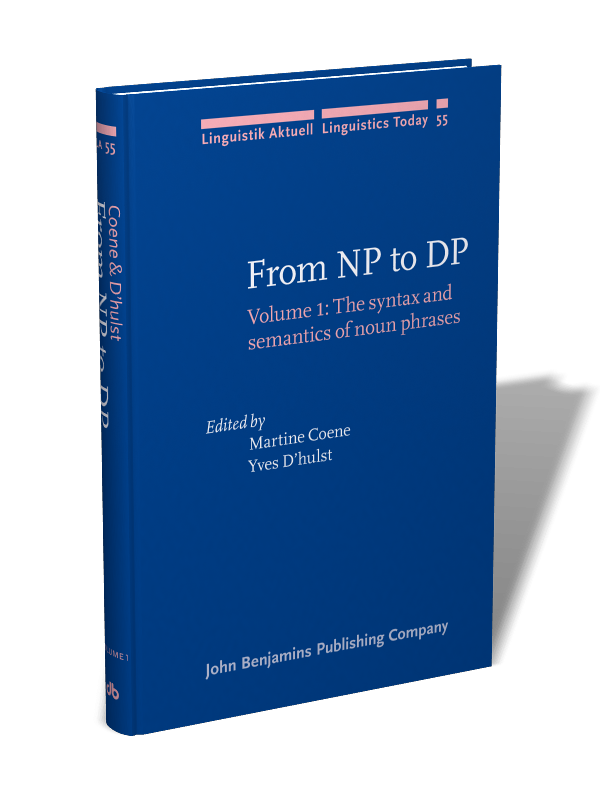
From NP to DP
Volume 1: The syntax and semantics of noun phrases
e-Book –ISBN 9789027296566 | EUR 130.00 | USD 195.00
Publishing status: Available

Table of Contents
-
Introduction: The syntax and semantics of noun phrases: Theoretical backgroundMartine Coene and Yves D’hulst | pp. 1–33
-
Introduction: Case studiesMartine Coene and Yves D’hulst | pp. 35–46
-
1. Determiner Phrases in Old and Modern FrenchPaul Boucher | pp. 47–69
-
2. On pro-nouns and other “pronouns”Rose-Marie Déchaine and Martina Wiltschko | pp. 71–89
-
3. Modification in the Balkan nominal expression: An account of the (A)NA : AN(A) order contrastMila Dimitrova-Vulchanova | pp. 91–118
-
4. Subnominal empty categories as subordinate topicsPetra Sleeman | pp. 119–137
-
5. ‘Transparent’ free relatives as a special instance of ‘standard’ free relativesAlexander Grosu | pp. 139–178
-
6. Resolving number ambiguities in Sakha: Evidence for the Determiner Phrase as a processing domainEdith Kaan and Nadezhda Vinokurova | pp. 179–193
-
7. Weak indefinitesGreg N. Carlson | pp. 195–210
-
8. Predicate–argument mismatches and the Adjectival Theory of indefinitesFred Landman | pp. 211–237
-
9. Determinerless nouns: A parametric mapping theoryGiuseppe Longobardi | pp. 239–254
-
10. A Russellian interpretation of measure nounsAlmerindo E. Ojeda | pp. 255–276
-
11. Generalizing over quantitative and qualitative constructionsJenny Doetjes and Johan Rooryck | pp. 277–295
-
12. On three types of movement within the Dutch nominal domainNorbert Corver | pp. 297–328
-
13. Semi-lexical nouns, classifiers, and the interpretation(s) of the pseudopartitive constructionMelita Stavrou | pp. 329–353
-
Index of languages | p. 355
-
Index of subjects | pp. 356–359
Determiner Phrases in Old and Modern French
pp. 47–69
Abstract
In this chapter I show how the syntax of Modern French DP (Déterminer Phrase) developed in a regular way from that of Old French DPs. We first see how the increasing use of Latin deictic pronouns attached to NPs eventually lead to destressing, then to loss of semantic content and finally to their reanalysis as definite articles. This evolution triggered a reanalysis of the extended nominal projection. The KP (Kase Phrase) of Latin had already become a DP by the end of the 9th century, the period of the earliest ectant Old French texts, where we see the ancestors of all the Modern French determiners already in use. In addition to the loss of case morphology, which is traditionally thought to lead to the rise of déterminer systems, I show, following Marchello-Nizia, that changes in stress lead to a reanalysis of both definite articles and demonstratives in Modern French. We now have a set of semi-affical articles which must accompany all referential NPs. This, I argue, is due to their reanalysis as agreement specifiers. Their adjunction to Agr is due to the loss of phonologically active number morphology in Modern French. This study therefore sheds light, not only on the process of language change, but also on the complex, interdependent factors which explain the syntax of Modern French DPs.
 La Boîte à Langues
Laisser un commentaire