
We seem to have returned to a time of myths. Migrants eat cats and dogs. Kamala Harris promotes abortions at nine months and probably eats babies as well. Diabolic scientists mix poisons into vaccines. Pizza parlors harbor satanic pedophiles.
It’s hard to determine to what degree such claims are really believed by those who make or hear them. It may be simply their way of expressing their hatred of the Others (migrants, Democrats, Wokists), believed to be the source of all that’s going wrong in their world.
But where do such fantastic notions come from? Are they based on facts, even remotely removed from current reality? Whatever the answer to that may be, the similarity between these ideas and certain myths and legends that have surfaced regularly since ancient times in periods of crisis and turmoil is striking.
{To continue reading, go to laboitealangues.com and click on “Mythes et legendes”.]
For instance, the baby-eating legend emerges regularly in times of crisis, such as during the Black Plague in the Middle Ages, when Jews were blamed for poisoning the wells as well as eating babies. Likewise, witchcraft and satanism are common favorites of the conspiracy crowd.
Another frequently recurring legend concerns transformations of humans into animals, most often wolves. Like old women riding broomsticks or Roumanian aristocrats emerging from their coffins to suck blood, werewolves are claimed to be the result of diabolic intervention, either brought about by the accused him (or her) self, or provoked by some external force.
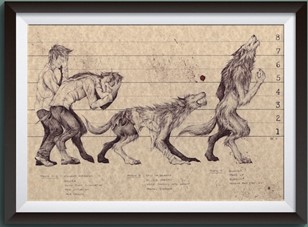
The werewolf, or lycanthrope, was said to roam the countryside at night in search of human prey. Covered with long hair, he (werewolves were usually men, as opposed to women, more likely witches) would typically have wolflike paws instead of hands and feet, bloodshot eyes and pale skin, be covered with scars from fighting with other wolves and show disordered behavior. Again, is there any basis in fact for such beliefs? There is, according to Dr. L. Illis[1] even if the link is rather tenuous and speculative.
“I believe that the so-called werewolves of the past may,” Dr. Illis writes, “at least in the majority of instances, have been suffering from congenital porphyria. The evidence for this lies in the remarkable relation between the symptoms of this rare disease and the many accounts of werewolves that have come down to us.”
Here is a description from the Toradja natives of Celebes (Dutch East Indies),
“Werewolves are described as having unsteady eyes with dark green shadows under them. They do not sleep soundly. They have a long tongue with red lips and teeth which remain red in spite of chewing betel nuts. Their hair stands on end.” (Illis, p. 24)
What is “congenital porphyria”? Here’s Dr. Illis’ technical answer.
“Congenital porphyria is a rare disease, due to a recessive gene, in which there is an inability to convert porphobilinogen to porphyrin in the bone marrow. The condition is characterized by:
(1) Severe photosensitivity in which a vesicular erythema is produced by the action of light. This may be especially noticeable during the summer or in a mountainous region.
(2) The urine is often reddish-brown as a result of the presence of large quantities of porphyrins.
(3) There is a tendency for the skin lesions to ulcerate, and these ulcers may attack cartilage and bone. Over a period of years structures such as nose, ears, eyelids, and fingers, undergo progressive mutilation.
(4) On the photosensitive areas hypertrichosis and pigmentation may develop.
(5) The teeth may be red or reddish-brown due to the deposition of porphyrins.
(6) The bone marrow is hyperplastic, usually in association with splenomegaly and hæmolytic anæmia.” (p. 25)
Recognize the symptoms? Photosensitivity, hence night roaming. Skin lesions, hence appearance of scarring. Pigmentation of the skin, reddish brown lips and teeth. Dr. Illis also notes that porphyria predominates in males and often results in “nervous manifestations”, as well as jaundice, hence the yellow skin, and “hirsuties”, that is, excessive growth of body hair.
The similarity between the descriptions of so-called werewolves and those of patients suffering from porphyria is such that little doubt remains as to the source of such claims, unless of course you’re determined to believe that werewolves, zombies, witches and vampires actually roam the earth today, that scientists poison vaccines and pizza parlors are full of satanic pedophiles. It all depends on which world you choose to live in, the world of fact or the world of fiction!
[1] Journal of the Royal Society of Medicine, Volume 57, Issue 1, 1964, 23-26.
https://journals.sagepub.com/doi/abs/10.1177/003591576405700104
 La Boîte à Langues
Laisser un commentaire